


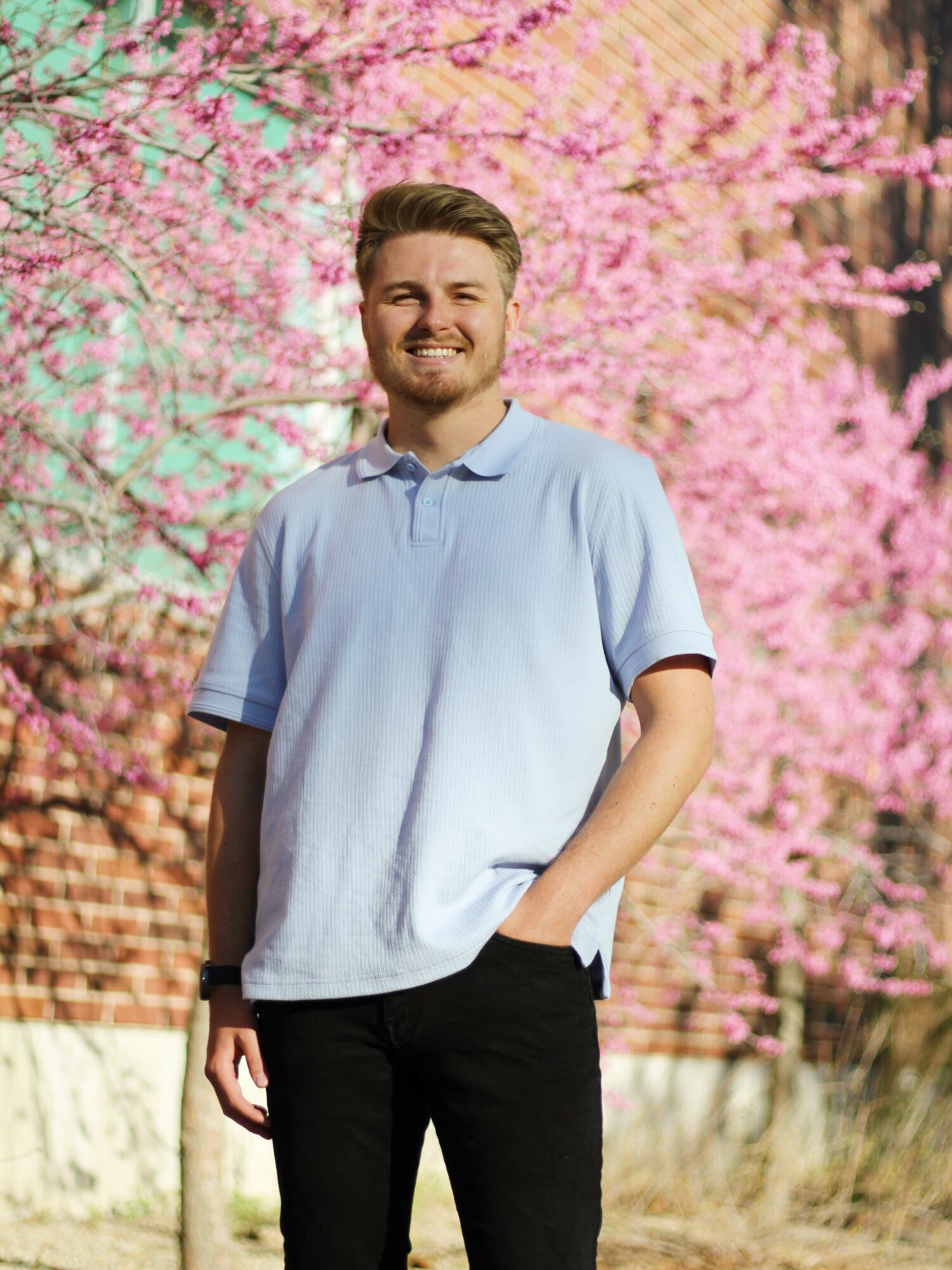
Today we’d like to introduce you to Drew Jackson.
Hi Drew, we’re thrilled to have a chance to learn your story today. So, before we get into specifics, maybe you can briefly walk us through how you got to where you are today?
My journey with Brainwaves, and indeed in life, can be understood through the lens of “doors.” Growing up, my dad always emphasized the concept of doors opening and closing, a piece of advice whose depth I only truly grasped over the past couple of years.
Each decision we make opens some doors and closes others. The goal, as he taught me, is to open as many doors as possible and close as few as possible, thereby maximizing opportunities. What I didn’t realize as a kid was the immense value of “transition doors”—those open doors not yet walked through and closed doors that were once open. These represent the options we have, and having more of them increases the likelihood of making a truly optimal decision.
For instance, the idea of starting a newsletter was a “closed door” for me until about age 15, simply because I didn’t even know it was a possibility. Once I became aware, it became an “open door,” though not immediately appealing. It wasn’t until the fall of my junior year in college, when I found myself with extra time and a desire for something productive, that new doors opened and existing ones gained value. At that moment, starting a newsletter felt like the “relative maximum” – the best option among those available to me. This led to the birth of Brainwaves, although it initially started under the name “Insights, Innovation, and Economics.”
To be clear, this initial concept was a random and impulsive idea. I had no prior experience running a blog, structuring content, or marketing. My very first introductory post clearly reflected this, with excerpts like, “I do not know how to run a newsletter, how to properly structure a newsletter, how to market a newsletter, or basically anything about a newsletter.” The initial logo and branding were, in my own words, “prime heritage,” showcasing my lack of direction. However, I slowly figured things out. I began writing on subjects I knew well, like intellectual property and nuclear energy. While initially reserved, my essays started to gain depth, and I learned the importance of curiosity in exploring new topics and refining my unique content style.
The journey continued with consistent reassessment and a significant rebrand. During a demanding investment banking internship, I used my limited free time to strategize, brainstorming over 50 changes for the platform. A key piece of feedback was that the name “Insights, Innovation, and Economics” wasn’t working. After much deliberation and many “tragic” name ideas, “Brainwaves” emerged. This new name, coupled with a redesigned logo and color scheme, truly embodied the evolving vision for the platform.
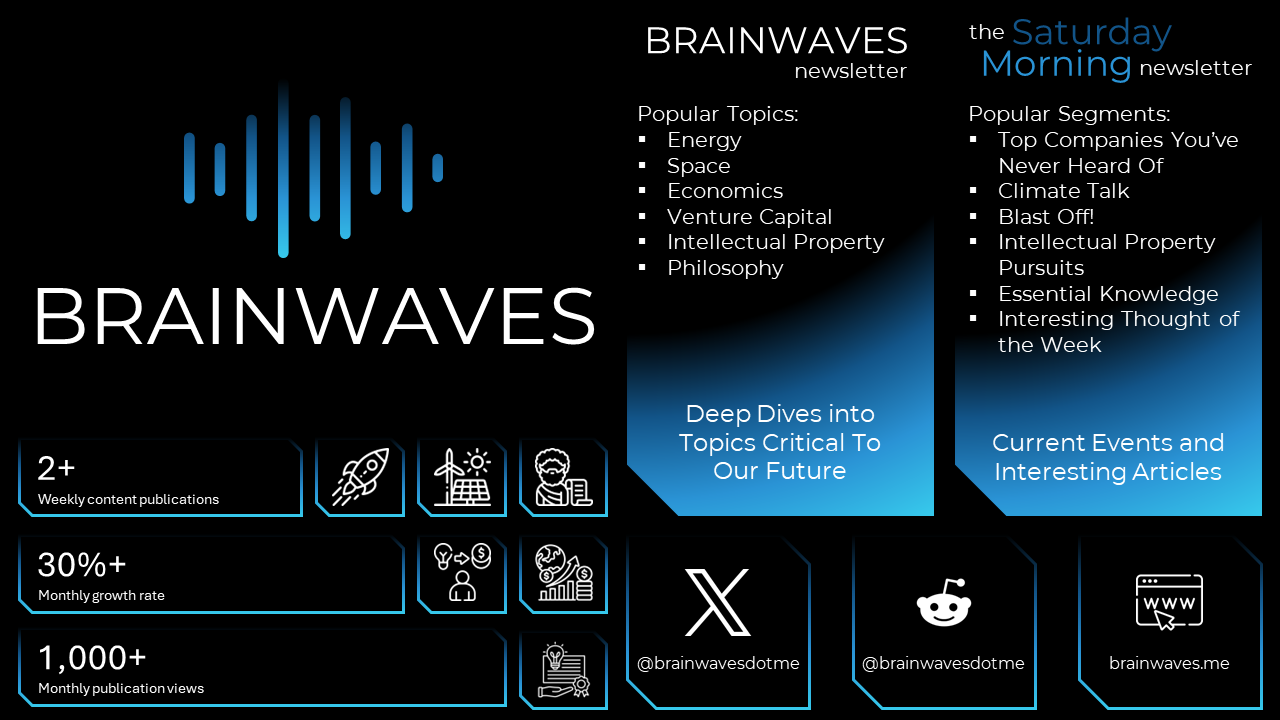
This rebrand formalized the expansion of content, the launch of a new website (a huge lift by my brother Tyler), and the introduction of “The Saturday Morning Newsletter.” It was a crazy milestone to hit 1,000 monthly views for the first time, a proof of concept that affirmed the value of continuing this venture. Over the past two years, my content has been read over 11,500 times, I’ve written 335,000 words (equivalent to around 4.5 Harry Potter books), grown from 0 to over 200 weekly subscribers, and had my marketing seen over 350,000 times. The future holds continued expansion, expression, and impressions, with a goal of reaching 1,000 subscribers one day.
Alright, so let’s dig a little deeper into the story – has it been an easy path overall and if not, what were the challenges you’ve had to overcome?
When I started this journey, I wasn’t certain what “my content” entailed. Throughout my schooling, I always wrote about obtuse topics that didn’t entirely resonate with me. I wrote mainly about topics that were mandatory – poetry, Russian literature, Old English texts, and more. The one thing that stuck out from these experiences was the love of writing and learning about philosophy, more specifically modern philosophy.
Besides this, most of my content interests came from my professional experiences. Chronologically, the summer after my freshman year I was with my aunt and uncle out in Pennsylvania. While there, I participated in a remote investment banking operations internship and conducted research with my uncle who is a Professor of Entrepreneurship at Penn State.
The investment banking internship was mainly boring busy work, but the research position was incredibly interesting. It was there that I was first exposed to nuclear energy (and other types of energy) and intellectual property rights. I dove into thorium micro nuclear reactors and university technology transfer, spaces that I found extremely interesting—ones I wanted to dive into further in the future.
Following this, I participated in a venture capital internship program by Battery Ventures, a prominent software-focused investment firm. Through this, I was exposed to my love of the venture capital and startup landscape. In addition, I was able to take another deep dive into the intellectual property space.
Besides my professional and primary education experience, I began studying economics at the University of Utah. My program specifically emphasizes the use of economics combined with strategy principles to identify and support individual business success. These learnings, coupled with experiences in the finance field focusing on understanding what makes companies valuable, have driven my love of companies and microeconomics.
Yet, even given all of this information, it was a journey when I started producing content. In the above explanation, I only highlighted the experiences that drove much of the content I write about today. However, there are many other professional, educational, or other experiences I’ve had that haven’t had a meaningful impact on my life in a personal interest sort of way like the above experiences had.
When beginning to write, I didn’t fully understand which of my past experiences I wanted to draw on and if any new subjects I wanted to add to my repertoire. For instance, my interest in the field of space was largely driven by interesting articles I saw in the media, nothing more. It took a couple of months of writing content before I knew that I wanted to investigate that sector further, and now you’ve seen multiple space articles.
It was interesting to discover the bifurcation between subjects I was interested in and those that I actually wanted to put time into to research and understand the minute details of the subject to competently write about in multiple articles. The list I previously thought I would be interested in writing about when I started this journey is not entirely the list that I currently write about today.
Thanks – so what else should our readers know about your work and what you’re currently focused on?
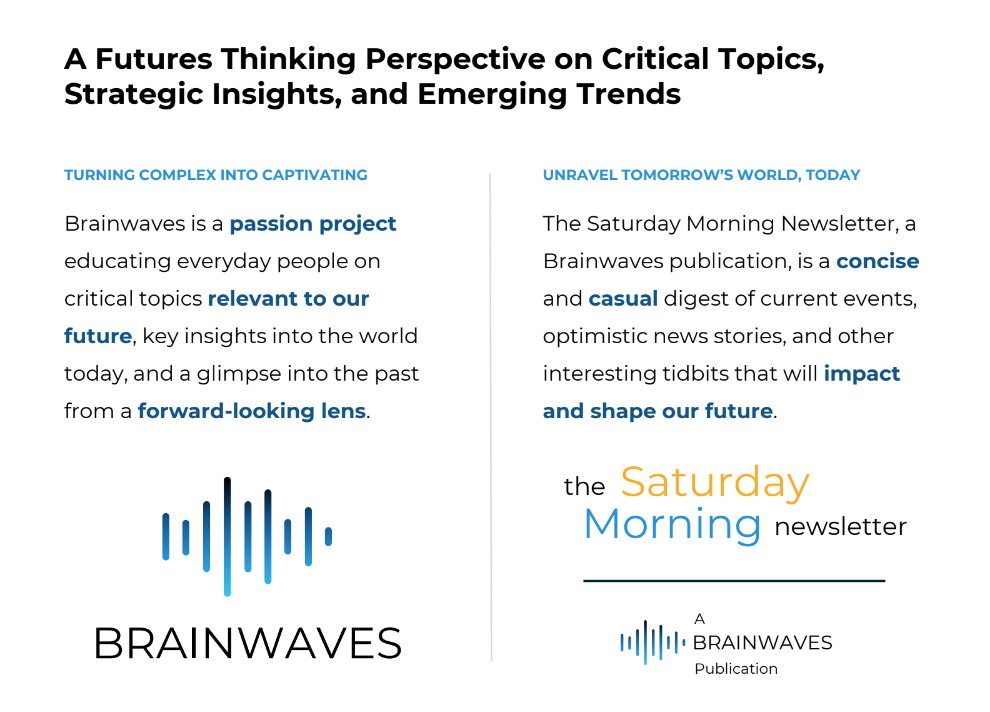
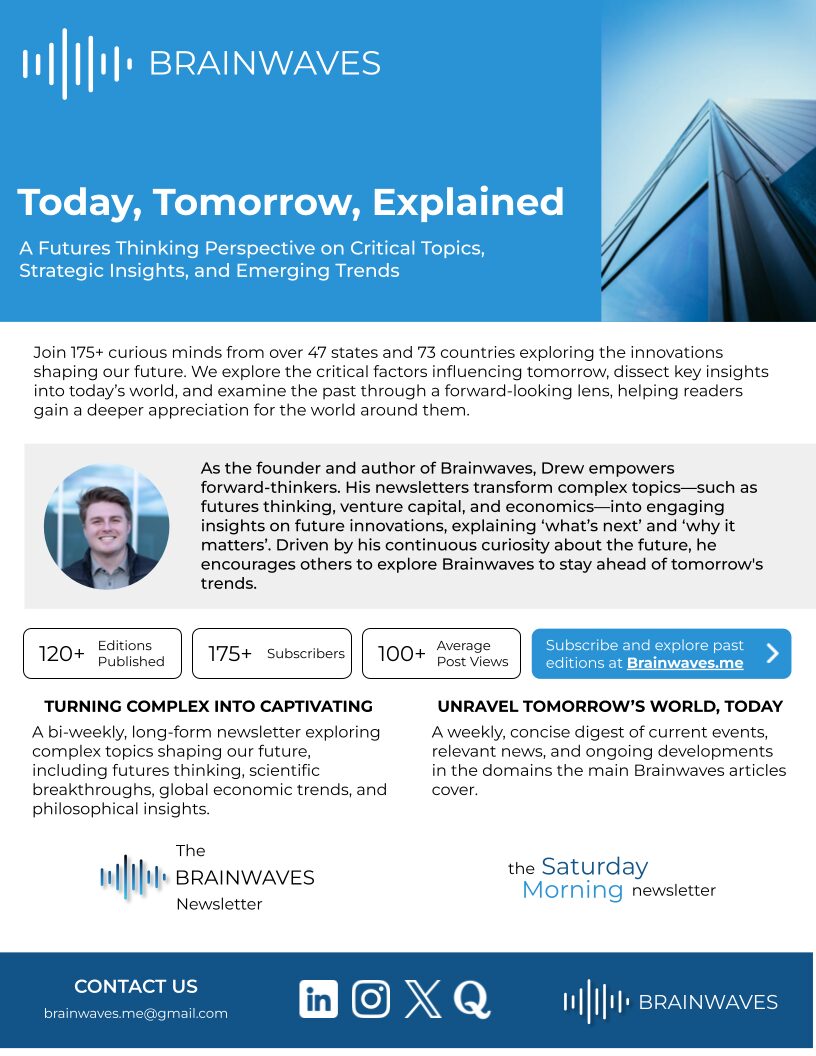
Brainwaves is your weekly destination for understanding the forces that shape our future.
We explore the critical factors influencing tomorrow, dissect key insights into today’s world, and examine the past through a forward-looking lens, helping readers gain a deeper appreciation for the world around them.
In an age of information overload, it’s easy to feel overwhelmed. Brainwaves cuts through the noise, delivering curated content that empowers you to think critically, make informed decisions, and gain a deeper understanding of the forces shaping our lives and futures.
Published every other Wednesday, the Brainwaves newsletter offers a deep dive into a single compelling subject that’s actively shaping our future. These articles go beyond the surface, providing an in-depth, approachable analysis that encourages you to ponder the possibilities and implications of innovation.
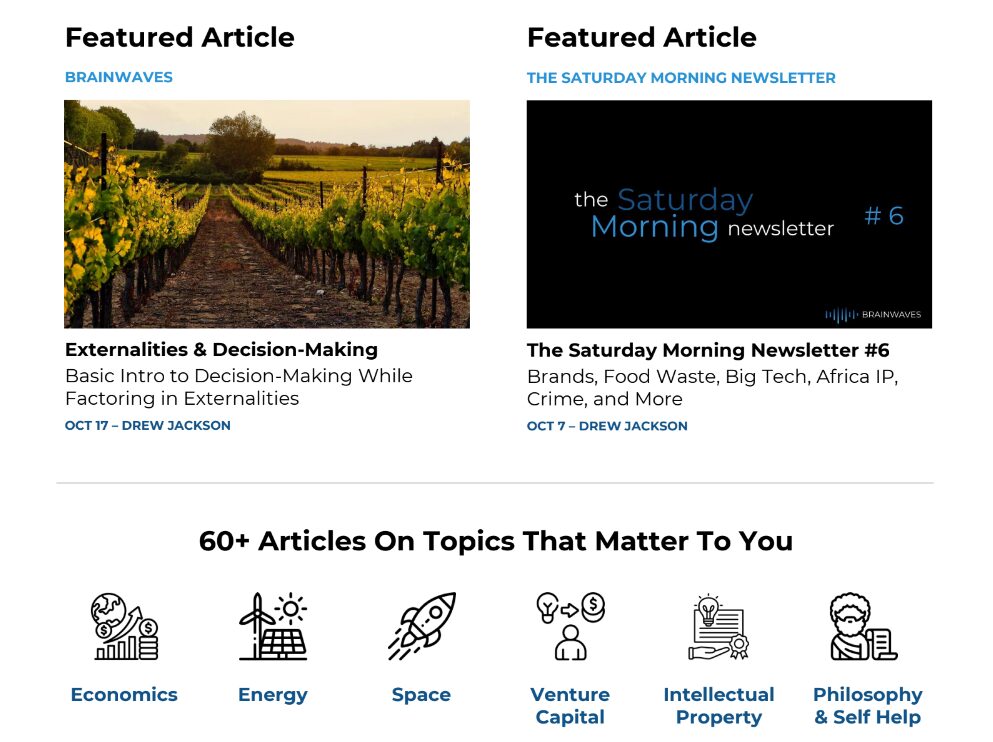
Major subjects discussed include: energy, space, philosophy, economics, venture capital, intellectual property, futures thinking, and many more.
We’d love to hear about any fond memories you have from when you were growing up?
Like everyone, it’s incredibly difficult to pick one favorite above all others, but here is one I look back on fondly as it helped bring me out of my comfort zone, give back to my community, and act according to my values as a person.
During high school, I had the opportunity to attend a Hugh O’Brian Youth Leadership conference. There, a peer told me their high school had five suicides in the last year. It was so distressing to hear. I knew I could do something to help reduce that number, so I developed a concept that used social media to make real friendships: Selfies 4 Good. The model was simple: a student would take a selfie with an unfamiliar student, upload it to social media, and comment one uplifting fact about them. This intentionally began a conversation and would help students feel less isolated and more connected, eliminating a risk factor for suicide.
I spent that summer crafting a website, establishing a social media presence, forming a club, obtaining approval and support from my principal, and collaborating with school influencers to boost involvement. I was ready to roll out my initiative.
Then came the frustration of little participation in the first months of school. I wasn’t going to let this important issue go unnoticed. So I decided to try a new strategy: leading by example. I took as many selfies with new people as possible and soon other students were positively affected and wanted to participate. I advertised monthly themes, giveaways, and contests. As the club began, we had social events and service projects focused on increasing awareness and inviting new student participation. Slowly, the levels of engagement climbed.
Months later, the club and initiative have vastly grew in membership, reflecting over five hundred hours of service. Students used the tools I created to increase in-person relationships, not just online followers.
Now, throughout my life I make sure to look for opportunities to reach out to people that I would have never met before starting this initiative. I may never know if I helped prevent someone from committing suicide, but by persevering through challenges, I was able to provide a network of support that increased the connection in our school.
Pricing:
- All Content and Subscriptions Are Completely Free
Contact Info:
- Website: https://brainwaves.me/
- Instagram: https://www.instagram.com/brainwaves.me/
- LinkedIn: https://www.linkedin.com/company/the-brainwaves-newsletter/
- Twitter: https://x.com/brainwavesdotme