


Today we’d like to introduce you to Danielle Dubrasky.
Hi danielle, thanks for joining us today. We’d love for you to start by introducing yourself.
I have loved writing and reading poetry from the time I was very young. I have been fortunate to have some wonderful mentors during my education who encouraged me to continue writing. One mentor was my 9th grade teacher in Charlottesville, Virginia, who assigned us to write a book of poetry. In her comments, she wrote that my poems were the most professional ones she had ever read. This comment stayed with me for a long time. During my high school senior year, I competed in a forensics competition for poetry reading. I had never participated in a forensics event before, but I read my own poems and eventually won the state competition that was hosted by the University of Virginia. I moved to Utah to go to college at Brigham Young University. During my Freshman year, a pivotal event happened–my father died of a heart attack. This loss was a shock and led to other changes, the main one being that my mother sold our home in Charlottesville and moved to the southern Utah desert.
While at BYU another mentor, the Welsh poet Leslie Norris, taught me about finding my lyric voice in poetry and to pay attention to how imagery and sound resonate in a line. However, he recognized something even more important–he saw a 19-year-old girl grappling with the heavy emotion of grief as I would turn in poem after poem alluding to loss. He finally asked who was I writing about. When I shared that it was about my father, he told me his own father died when he was 12. I remember him saying, you never truly get over it–you will live with the grief for most of your life. Rather than feeling hopeless, I remember thinking that someone finally understood me, understood my frail young adult loneliness and my attempts to corral all that sorrow by using words to shape the confined space of a poem. Over the years, my poems have addressed this loss in many ways and have been a conduit for my own healing.
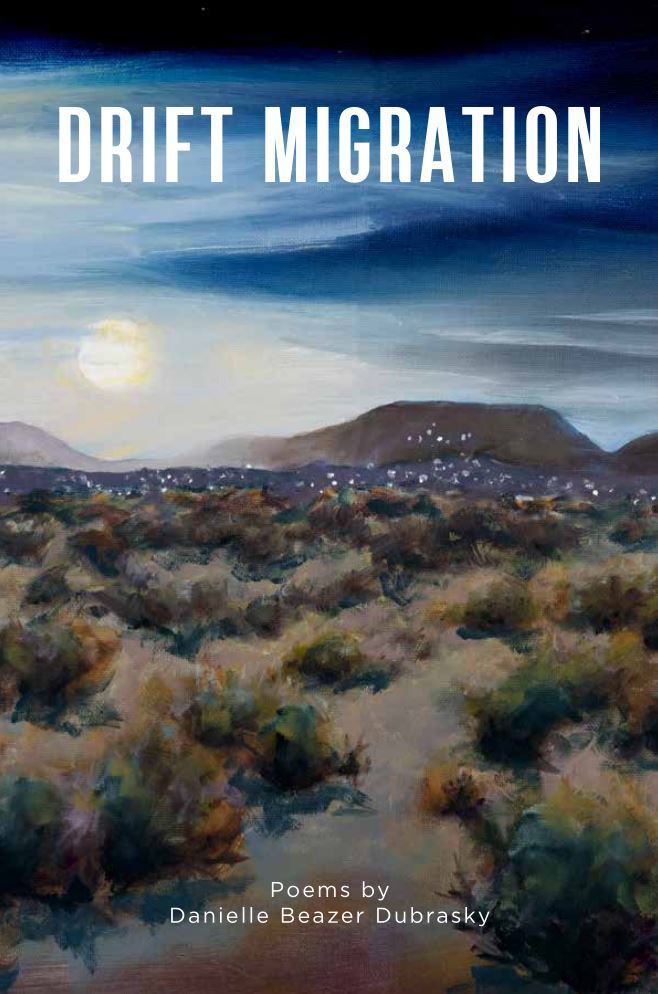
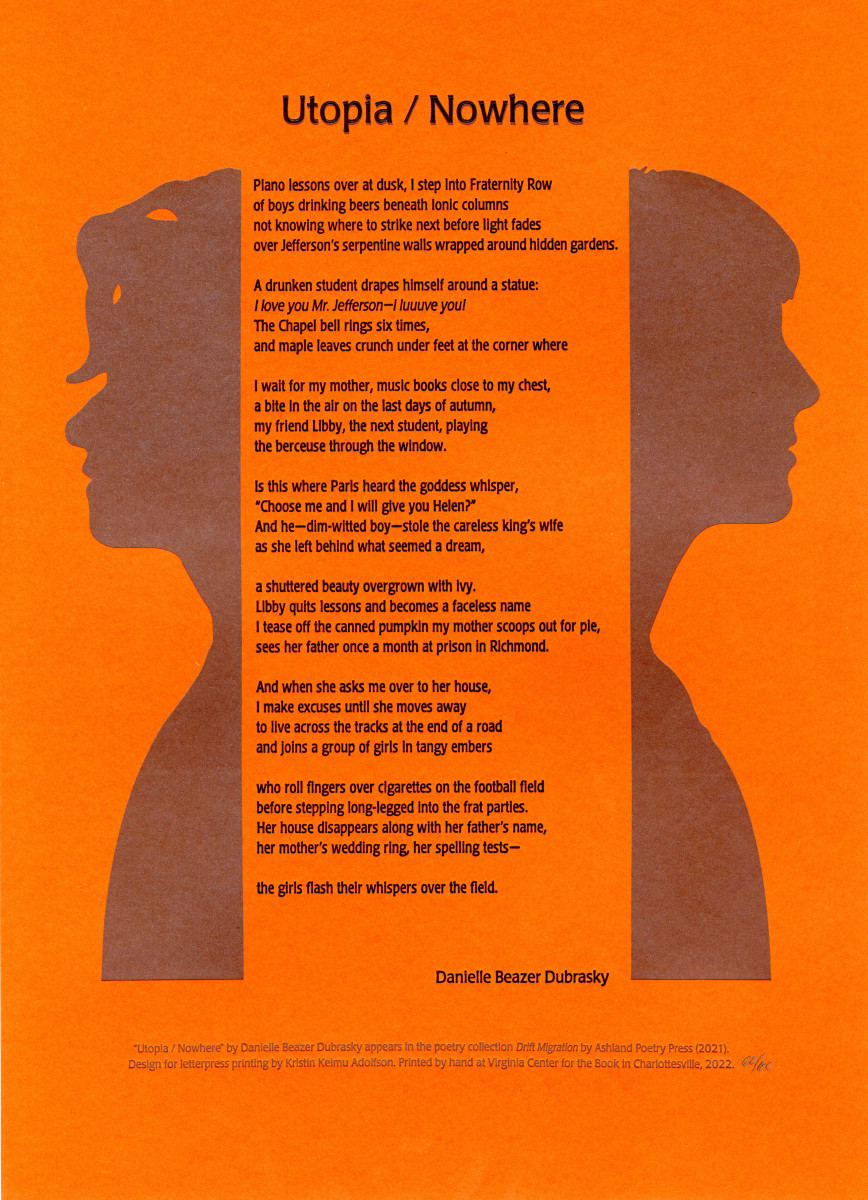
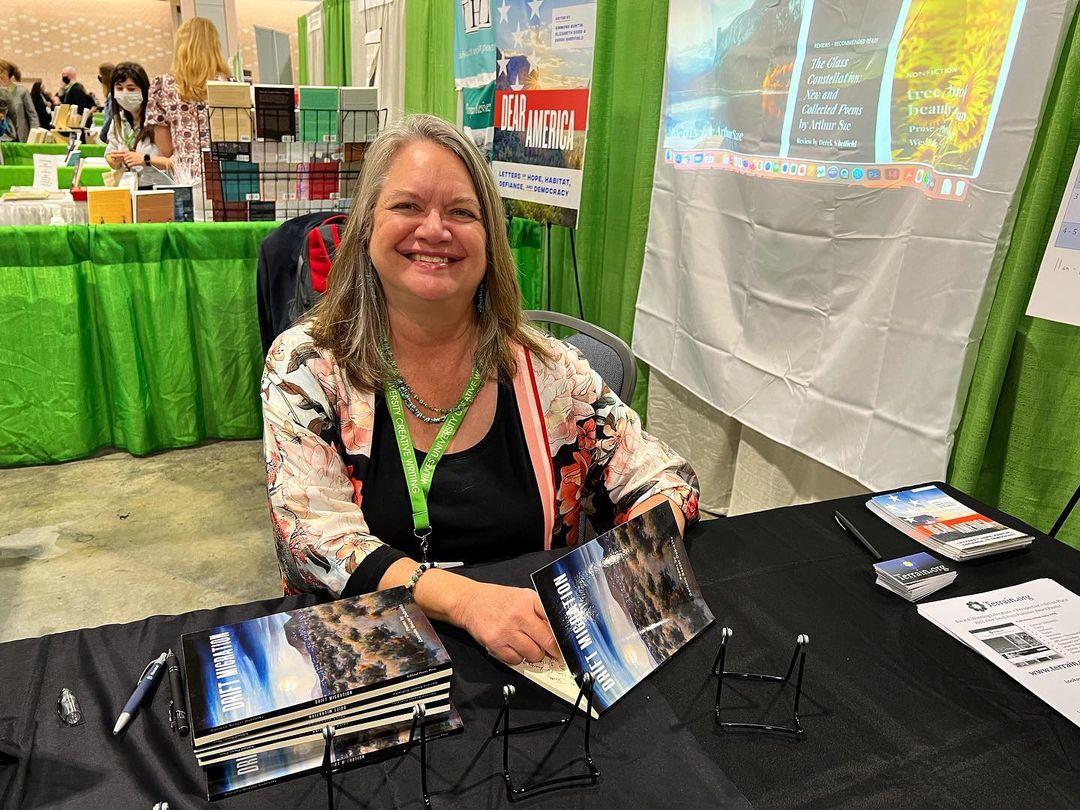
After college graduation, I worked for two years as a free-lance editor in Boston before I was accepted into Stanford’s master program in Creative Writing. My next mentor was the poet Simone Di Piero. He talked about what he called the “mind behind the poem” and gave me ideas for teaching poetry using a holistic approach. With his encouragement, I applied to teach for one year at Brigham Young University and then was fortunate enough to be hired at Southern Utah University, where David Lee, who became the first Utah Poet Laureate, was the department chair. He had already established a strong legacy of bringing visiting poets to SUU, so there was a vibrantly creative atmosphere. I eventually completed a PhD in Creative Writing from the University of Utah where I again worked with some terrific poets and mentors. I have taught poetry writing at Southern Utah University for over 30 years while also publishing my own work. As a professor at SUU I have developed a fall creative writing conference as well as international creative writing classes. I have been a Fellow at the Virginia Center for Creative Arts and have been a visiting writer for the Dylan Thomas Summer School. My book, Drift Migration, was one of those published during the pandemic in 2021, so I am still getting the word out about it. It focuses on themes of landscape and connections to place through imagery from both my homeland of central Virginia and my adopted place of Southern Utah. It contains two long poems that retell myths as a way to address loss and renewal: “The Sand Man” and “Eurydice’s Mirror.”
Can you talk to us a bit about the challenges and lessons you’ve learned along the way. Looking back would you say it’s been easy or smooth in retrospect?
I mentioned my love of poetry, but I did not mention how that love went beyond aesthetics. In many ways, poetry has guided me as I have navigated a variety of challenges. When I was young, I had a very active imagination. I was a “dreamy” child and poetry helped me to focus my imagination, and even my attention, so that over time I could channel any intense emotion or day-dreamy distraction into a poem. I also mentioned my father’s death and how that changed many aspects of my life at a young age. I struggled with not being able to return to a place that I loved, Virginia, because it was too painful to go back knowing that nothing would be the same. I had to find another way to compensate for that loss, which I did by writing about the place as a way to bring it back through memory.
The second struggle was the process of publishing my book. Over the years, I sent out my manuscript to many press competitions and it gained recognition several times as a finalist. In the mean time I continued to revise it with input from one of the best poets and editors in Utah, and a good friend, Nano Taggart. I also consulted with another reader to help me restructure the manuscript. This process took several years before a poetry editor of Ashland Poetry Press, Deborah Fleming, selected it for its “Editor’s Choice” publication. That press published a beautiful book with cover art by Cedar City artist Diane Walsh. It was the culmination of many years of hard work while still teaching full time==thus, I was ecstatic when it finally made it to print.
Thanks – so what else should our readers know about your work and what you’re currently focused on?
In terms of my work, I am a professor of poetry at Southern Utah University, as well as the director of the Grace A. Tanner Center for Human Values. I teach both intermediate and advanced poetry while curating the Grace A. Tanner Lecture series at Southern Utah University in consultation with an interdisciplinary faculty advisory board. Through that lecture series, we have brought scholars and creatives of various disciplines to SUU including Jelani Cobb, Maria Hinojosa, and Camille Dungy, whom I had a chance to interview. In 2022 the Center celebrated its 40th anniversary and we had the opportunity to host the actor Geena Davis. One aspect that perhaps sets me apart as a professor of poetry is that I teach my advanced poetry students the Lyric Sequence. The students write a collection of thematically linked poems that can eventually become a chapbook. In guiding them through the process, I see them become so engaged with their writing as they work through various ideas that they take their poetry to very powerful places. I also direct a creative writing conference at SUU that brings visiting writers to campus to work with our students to give “Craft and Career Workshops.”
As a professional writer, I am primarily known for my poetry. I have been published in several journals, including Sugar House Review, South Dakota Review, Ninth Letter, Chiron review, Terrain.org, among others. Two of my poems will be part of an exhibit at the Springville Art Museum: “In This Together: Art, Belonging, and the Urgency of Social Connection: from Nov. 18 to July 3, a project that involves visual artists and poets curated by poet Rachel White. https://www.smofa.org/in-this-together. However, I have also been recently expanding beyond poetry into writing creative nonfiction. One of the first essays I published won the 2021 Mississippi Review first place in creative nonfiction. Since then, I have been commissioned to write essays in three anthologies–The Once and Future Lake: Stories for the Great Salt Lake; Zion: Valley of Wonder; and Blossom as the Cliffrose: Mormon Legacies and the Beckoning Wild, a collection that I co-edited with award-winning writer Karin Anderson.
I am most proud of two things. I am very proud of the book Drift Migration as it was a culmination of many years of revision and hard work. I feel that it captures my own journey of being blown unexpectedly “off course” because of past circumstances. I also like to think that I have contributed to the literary experiences of my students at SUU by helping them navigate their own poetry journeys through my classes, the creative writing conference, and international programs.
Let’s talk about our city – what do you love? What do you not love?
Cedar City is a place of natural beauty. I am drawn especially to the sunsets and the onset of twilight over the western mountains. As someone who grew up on the east coast with a love for the beach, the hikes through red rock with blue sky can seem spiritual in a similar way. This university town is also unique in that it is the home of the Utah Shakespeare Festival. It is rare to be in a location where you can hike through Kolob Canyons or other national parks one day and see a stunning production of Hamlet or Macbeth the next. There are some terrific local galleries and restaurants downtown (Artisans Gallery, Centro’s Pizza, the Pub Craft Kitchen) as well as some excellent Thai and Indian restaurants (shout out to Bunnisa’s Thai!). It is also a thriving community in terms of music, the arts, book clubs, and more recently the Southern Utah Book Festival. What the town can improve on is having a more coherent sustainability plan regarding water conservation, recycling, and zoning to prevent over development, as well as limiting data centers–a challenge for many rural communities in the west.
Pricing:
- Drift Migration, Ashland Poetry Press, &17.95
- The Once and Future Lake: Stories for the Great Salt Lake, $23.95
- Blossom as the Cliffrose, Torrey House Press, 21.95
- Zion: Valley of Wonders, Wildsam Field Guides, $20.00
- Invisible Shores, Red Butte Press, $40.00
Contact Info:
- Website: https://danielledubrasky.com/
- Instagram: https://www.instagram.com/cliffrose123/
- Facebook: https://www.facebook.com/danielle.dubrasky
- LinkedIn: https://www.linkedin.com/in/dani-dubrasky-a375228/
- Youtube: https://www.youtube.com/watch?v=cCkg14-OHzs
- Soundcloud: https://soundcloud.com/sugar-house-review/petroglyphs-at-parowan-gap?utm_source=thesoundofsugar.blogspot.com&utm_campaign=wtshare&utm_medium=widget&utm_content=https%253A%252F%252Fsoundcloud.com%252Fsugar-house-review%252Fpetroglyphs-at-parowan-gap
- Other: https://www.youtube.com/watch?v=Et_PT2VhCiU https://www.terrain.org/2017/poetry/danielle-beazer-dubrasky/