



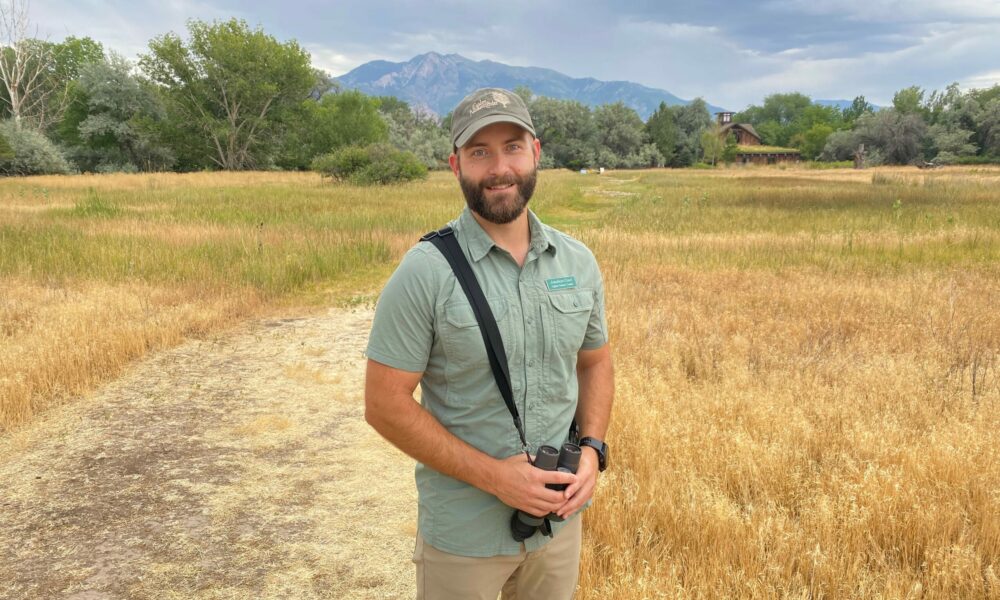
Today we’d like to introduce you to Jonathan Creel.
Hi Jonathan, so excited to have you on the platform. So before we get into questions about your work-life, maybe you can bring our readers up to speed on your story and how you got to where you are today?
I grew up in the panhandle of Florida (the woods, not the beach) and spent most of my days outside playing sports and riding bikes. Looking at the wall of green underbrush all around me, and having a football coach for a father, getting outside for things other than sports was not high on my priority list. Though, when I visited my grandmother, she knew all the bird songs and captivated me with stories from her life “out west.”
They eventually sprouted when I took a college class that took me on a month-long road trip from Florida to California and back, where we visited national parks and historical sites along the way. Watching the wall of underbrush slowly fade to the mesas and mountains of the desert southwest was all it took – that was it for me. I was hooked. My original “plan” for life vanished, and I started down the path that eventually brought me to the Ogden Nature Center.
I began a master’s program at the University of West Florida and was lucky enough to find a “thesis” project in Yellowstone National Park. There, I created an interpretive plan and helped design elements of the redesign of the Albright Visitor Center in the Mammoth Hot Springs area of the park. The next year, I served my first season as a park ranger, flat hat and all, in Yellowstone at Norris Geyser Basin. That was a transformative experience for me. After spending time in all the different areas of the park, watching a pack of wolves chase an elk into a pond, finding myself chasing a grizzly bear sow and cubs out of a campground, helping carry a trapped grizzly from the same campground, and witnessing a new thermal feature pop out of the ground, I found my passion for communicating about the natural world.
After graduating, I chose not to return to Yellowstone, and instead accepted a park ranger position in Glen Canyon National Recreation Area, specifically the Lee’s Ferry location in Marble Canyon. There I was fascinated by the largest bird in North America, the California Condor. These incredible birds, with their 9.5 foot wingspans, perched on the cliff walls and struts below Navajo Bridge. I’d even occasionally have to “shoo” them off the bridge in the mornings! After that, I accepted a position in Grand Canyon National Park, where I lived for almost two years. At Grand Canyon, I truly became a “hiker” and found myself constantly exploring the various trails of the South Rim. I began as a park ranger, but ended up joining the official non-profit partner for the park, Grand Canyon Association (now Grand Canyon Conservancy).
Eventually, I discovered a job posting at a small non-profit nature center in Los Alamos, New Mexico. They were searching for a Director of Interpretation to design exhibits for a new building that was under construction. I jumped at the opportunity, because I fell in love with northern New Mexico while on the cross-country class trip in college. After joining the team of the non-profit Pajarito Environmental Education Center (PEEC), I designed exhibits, planned community programs, oversaw a planetarium, and forged partnerships across the region.
It was also in Los Alamos that I found another passion: birding. (Birding is what intense bird watchers say we are doing, so you’ll hear those terms interchangeably!) A few friends finally coaxed me into trying it, and after discovering the community-science initiative, eBird, I was a full-fledged (pun intended) birder. Now, you’ll rarely see me on the trail without a pair of binoculars and a camera.
After working at PEEC for over six years, I left the field of environmental education and joined Los Alamos National Laboratory (LANL) as a liaison between the National Park Service and the Department of Energy for the Manhattan Project National Historical Park. While at LANL, I also had the opportunity to oversee the development of an interactive traveling “museum” experience called Challenge Tomorrow.
However, I found myself missing the field of environmental education and found the Ogden Nature Center (ONC). ONC’s mission, to unite people with nature and nurture appreciation and stewardship of the environment, matches my own personal values and I knew it was a great fit. I was fortunate to be selected for the role of Executive Director.
Environmental education and a stewardship ethic weren’t things I grew up with, instead, I sought them out and came to them naturally. Now, I’m an avid birder and backpacker, and more recently discovered the world of packrafting. This is the reason I am so passionate about, and understand the value of, environmental education: I didn’t have that growing up, but eventually found my way there, and it changed my perspective. Yet, that opportunity isn’t available to everyone. Experiences like those we offer at the Ogden Nature Center truly do make a difference and change lives. What we do ignites a child’s interest – or that of an adult – and instills a value of stewardship.
Ogden Nature Center isn’t just an oasis in the heart of Ogden, it is also an important rest stop for birds on one of the most crucial migration flyways in North America, a living laboratory for studying the natural world, and one of the first places our local children come to experience the natural world. What we do here makes a difference in our community and the lives of those who grow up here. We’re lucky to have such an amazing community resource that is accessible to everyone.
Can you talk to us a bit about the challenges and lessons you’ve learned along the way. Looking back, would you say it’s been easy or smooth in retrospect?
The road has had bumps and curves for sure!
Working as a seasonal ranger and traveling every six months sounds poetic and glamorous but comes with its own challenges. While in those roles, people find themselves always wondering or worrying about the next position and thinking about what to do in the meantime if a coveted “winter gig” doesn’t present itself.
Since realizing that my passion was communicating about the natural world, environmental education, and stewardship of natural resources, I’ve followed my “gut” when deciding on the next step along the way. I’ve felt extremely fortunate in each step of the journey that brought me here, and worked very hard to succeed in each of the various roles.
Honestly, the most challenging obstacle I faced was losing both parents while relatively young. In fact, losing my dad changed my perspective quite a bit and I found myself pursuing my passions and making time for the things I find personally important. I took a step back and made sure to focus on what makes me happy – traveling, exploring new places, looking for new birds – rather than worrying about the next “step” in my career.
Appreciate you sharing that. What should we know about Ogden Nature Center?
A group of community members founded the Ogden Nature Center in 1975. In fact, we are Utah’s first nature center! The mission of the Ogden Nature Center is to unite people with nature and nurture an appreciation and stewardship of the environment.
Today, our 152-acre preserve serves as a living classroom for environmental education. Each year, the Ogden Nature Center brings more than 50,000 children, teachers, and adults together with nature through hands-on field classes, community programs, summer camps, community events, summer concerts, star-gazing events, outdoor date nights, and more! We host several major community events each year including an Earth Day Celebration and the upcoming Creatures of the Night at Halloween!
We also provide a space where people can explore trails and see wildlife up close. You’ll often see deer grazing at the center and can see so many different bird species along our trails. We also provide a home for non-releasable birds of prey and other animals, and they serve as animal ambassadors to teach children and adults how to be better neighbors to our local wildlife. Visitors love meeting our resident eagles, owls, hawks, raven, tortoises, snakes, salamanders, and other native species.
While we do specialize in environmental education and provide field trips and in class lessons across the state, there is something for everyone at the Ogden Nature Center! We are proud to serve as a community hub and a model of sustainability for the Ogden community.
Are there any apps, books, podcasts, blogs or other resources you think our readers should check out?
Most of the podcasts I listen to are about birds, conversation efforts around the world, and non-profits in the stewardship world. I have found that Joan Garry’s podcast generally has something worthwhile on any topic in the non-profit leadership realm.
In Utah, the Utah Nonprofits Association does great work and our local United Way of Northern Utah is a wealth of information! They have quickly become the first place I turn to for resources.
Contact Info:
- Website: https://www.ogdennaturecenter.org/
- Instagram: https://www.instagram.com/ogdennaturecenter/
- Facebook: https://www.facebook.com/Ogdennaturecenter/