



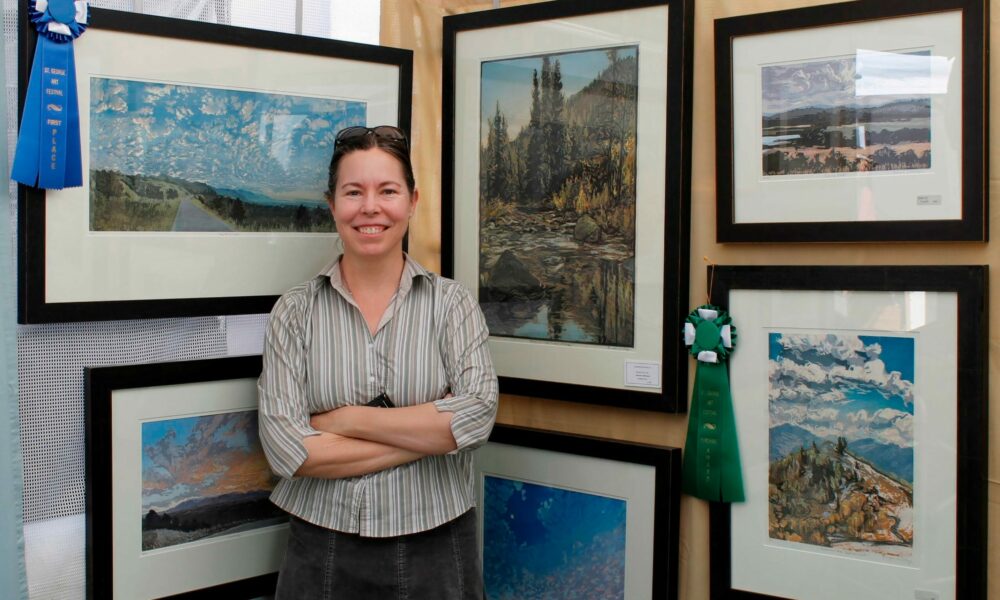
Today we’d like to introduce you to Jennifer Worsley.
Alright, so thank you so much for sharing your story and insight with our readers. To kick things off, can you tell us a bit about how you got started?
I decided I wanted to become an artist when I was 12, and took as many classes in painting as I could find, both in school and outside of school. I always enjoyed landscape painting the most, but also loved both figure drawing and sculpture. I studied art in college at Boston University, where I got a BFA degree.
When I discovered pastel, after graduating from college, it was a major “ah ha!” Pastel is a wonderful way to combine drawing and painting, especially in landscape work. After that discovery, I was focused, and for many years I took my pastels out almost every day, to work on location at whatever spot grabbed my attention. I have favorite spots, but new places seem to reveal themselves all the time. The incredible variety of mountain, desert, and lake scenery around Utah, in 4 dramatic seasons, has been endlessly inspiring. There is no other place I can imagine being as a landscape artist. One of my favorite subjects for pastel has been the east-west flowing streams coming out of the Wasatch canyons. The changing light coming through the canyons, and falling on the streams at different times of year, has captured so much of my attention working in pastel outdoors.
My second “ah ha” art discovery was moku hanga woodblock techniques, which have a long and beautiful tradition in Japan, where the technique originated. It has allowed me to combine my other artistic love, sculpture, with landscape. The carving and printing process has been a fascinating technique to learn, and it’s so well suited for atmospheric landscape effects. I now find myself with two major art techniques that I love. Interestingly, they are quite opposite: my work in pastel is very immediate and direct, and I tend to work quickly to capture a momentary landscape effect. Woodblock printing is slow, requiring lots of planning and experimenting. I enjoy the way the two opposite techniques play off each other in creating landscape images.
Can you talk to us a bit about the challenges and lessons you’ve learned along the way. Looking back would you say it’s been easy or smooth in retrospect?
Both pastel and woodblock printmaking have a long history, but they tend to be quite unfamiliar to art collectors, compared to oil painting. Although I love both techniques and find them endlessly fascinating to explore, conveying the processes to collectors can be difficult. The moku hanga technique in particular is very elaborate. A lot of art galleries find that too much of a challenge, especially when they are unfamiliar with the techniques as well. I have found that bringing my work to outdoor art festivals, where I can explain my own processes in detail, has been the best way to overcome this.
Can you tell our readers more about what you do and what you think sets you apart from others?
Utah is a wonderfully inspiring place for landscape painting, and there are many great landscape artists who live and work here. I use very different techniques in pastel and woodblock printmaking, compared to most landscape artists. When I am working in pastel, I am constantly scanning my surroundings for shadows passing over hills, sparking light on water, or a particular moment of harmonious color in a sunset. I often discover subjects by chance, and will get out my pastels and complete the painting on the spot. I make my own pastel chalks from raw pigment powder, creating colors I could not find in commercially available pastels.
Woodblock printmaking requires a careful plan and lots of time to create an image, making it completely opposite to the way I work in pastel. I often use a reduction method of carving, which involves printing the woodblock in one color, carving some areas of the block away, and printing it again in a new color. This continues until I have the final image. The first color I print is usually the lightest, and the last is the darkest.
I think the way each of these two techniques informs and influences the other in my own art is quite unique. My woodcut images are often inspired by a pastel or drawing that I have done, and the qualities of both come through in my imagery. I can see a landscape as either a light-filled, atmospheric pastel, or as a more stylized and graphic woodblock print.
We all have a different way of looking at and defining success. How do you define success?
Success for me is getting to spend my whole life making art. Whatever is required to make that happen is essential – and not all of it is just practical matters. I think one of the more ephemeral aspects of success is feeling the enjoyment of going into the art studio or out into the field to make new work- if you lose that engagement, as an artist, you have lost everything. As long as you have that engagement with your craft, it’s a wonderful way to give your entire life meaning. That is what I consider success”.
Pricing:
- Prices for my pieces range from $75 to $1200
Contact Info:
- Website: www.jenniferworsley.com
- Instagram: https://www.instagram.com/jenniferworsleystudio


Image Credits
Photos of Jennifer taken by Cliff Smith