


Today we’d like to introduce you to Jorge Rodriguez.
Hi Jorge, thanks for joining us today. We’d love for you to start by introducing yourself.
I am an artist, educator, and radio host.
I graduated from Utah Valley University with a BFA in Visual Arts and Communication. The focus of my work is to help provide a vehicle through which important social/ethnic issues can be discussed. I hope to further awareness of the many areas in our society that need improvement.
I have worked in education for the last 15 years, first in private school organizations, then in-state school districts both in Park City and Salt Lake City. I also work with multiple non-profit organizations using art as a medium for healing, self-expression, and cultural and sociopolitical expression.
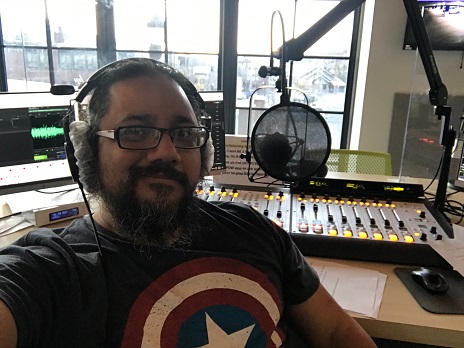
I wished to help give a voice to the Latino community and realized that the radio show Cada Domingo on KPCW Community Wireless of Park City was a perfect platform to do so. (Park City is a wealthy ski community with a large population of Latino workers, mostly of Mexican origin.) This show is one of the few radio shows in Spanish in Utah that delve deeply into cultural, social, and political issues that affect the Latino community.
Through my work with Artes de México en Utah, a non-profit organization, I have had an opportunity to aid with the efforts of bringing community organizations to Utah and promote the appreciation of Latino Cultures and highlight the contributions of influential Latinos in the state.
We all face challenges, but looking back would you describe it as a relatively smooth road?
I now understand how my particular neuro-diversity has meant many disadvantages for me in the world I grew up in.
Living in a time when neurodivergence was not recognized, I spent the vast majority of my life thinking I was simply terrible and lazy. I have now come to understand that my particular “hardware” is wired a specific way, and “willing myself” out of it is simply not possible. This meant a lifetime of different strategies in order to overcome my challenges with many failures and successes.
I always knew I wanted to be an artist in some capacity or another, but felt that I had to “hold a real job” and ended up letting my artistic expression take a back seat for most of my life. One night, while on a guard shift in a Kuwaiti desert during my military service, I decided that when I returned to the mainland, I would work towards being an artist. Unfortunately, the reality is that being an artist and making a living from your art is not easy, and I’ve struggled to balance “work” and “play”.
One of the biggest challenges I have faced is holding back my passion for bringing light to socioeconomic, political, and cultural inequalities and injustices within existing organizations. I have seen systemic injustice towards others and felt powerless to remedy them. This has led to me being particularly picky about the organizations I choose to work with.
I am very critical when there is a blind eye turned to obvious inequities and injustices, and do not have a filter. This makes me difficult to work with at times. I am also notoriously terrible at self-promoting, which is why I prefer to use my time promoting and elevating others.
As you know, we’re big fans of you and your work. For our readers who might not be as familiar what can you tell them about what you do?
I use my art as a vehicle to address topics I find interesting, important, or relevant. In most cases, these are political in nature. The challenge is to talk about a political issue without telling the viewer their views are wrong or bashing them over the head with the issue.
I do my best to make work that can lend space to talk about these issues, invite the viewer to view the realities of the world we live in, and reflect on our roles as individuals in these concepts. With Cada Domingo, I realized I had a platform, and as such, it is my responsibility to give a voice to those who usually don’t. It is why I focus on bringing guests to talk about issues and topics relevant to the marginalized and underprivileged.
I feel that the role of a community radio station is to represent all the voices in the community, not those of the privileged, which is why I invite non-profit organizations focusing on addressing inequities, individuals with powerful messages, and those who promote the well-being for the community.
Do you have any advice for those just starting out?
Volunteer ANYWHERE and often, even in places you might not think you’ll enjoy.
When I was finally able to finish my higher education, I came to realize that if I had volunteered more at a variety of places, I would have had a better understanding of the kinds of things I liked, and more importantly, understood what places I didn’t like. And if you are passionate about a specific issue, work in that field.
When I was young, I thought I knew what things I liked, and what things I didn’t like. For example, I knew I didn’t like board games and was convinced the most fun places were exclusively the most frequented by the cool kids. I worried so much about liking the “wrong things” that I didn’t try out many things that I kind of found interesting.
After a lifetime of experience, I learned that many things I was sure were boring turned out to be really fun to me, and many of the things I was convinced were the most fun really didn’t hold much interest to me. I even came to realize that board games are actually really fun with the right company. My opinion of those things was what mattered, not what others thought of it. Branch out of your comfort zones.
Contact Info:
- Email: rodrig.jorgel@gmail.com
- Website: artesmexut.org