



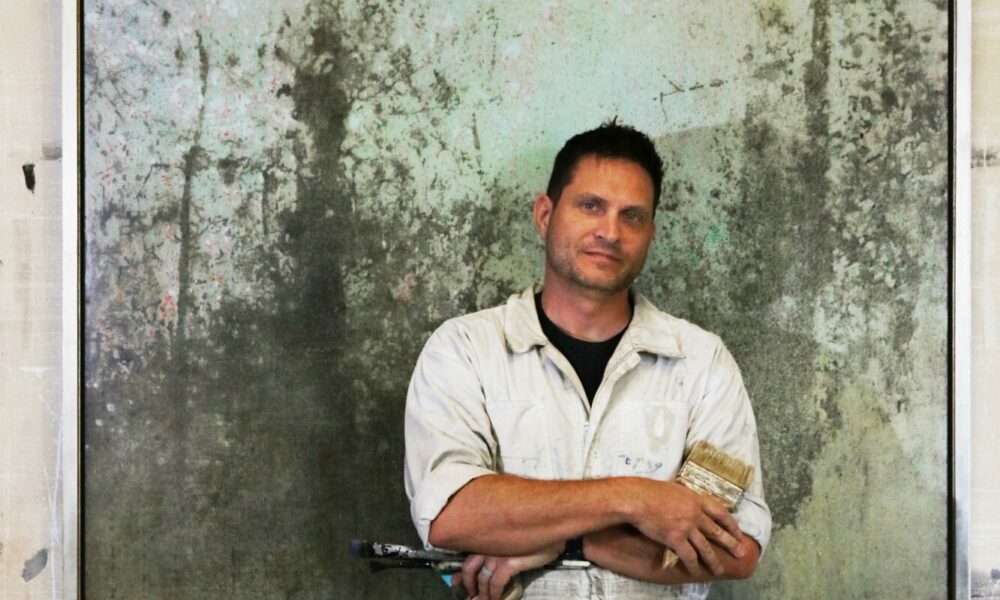
Today we’d like to introduce you to Tyler Huntzinger.
Hi Tyler, we’d love for you to start by introducing yourself.
I formed a strong commitment to my art at an early age. Becoming a maker is a tradition in my family sprawling across generations. Some of my earliest memories involve the exploration of color and its relationship to the world. I completed my studies in fine arts at the University of Utah, concentrating on drawing, painting, printmaking, and ceramics. My painting process remains heavily informed by my early pursuits in ceramic glazing.
My painting is my search for a connection to the seemingly alien world surrounding me. I am fascinated by the ways living creatures affect one another and change the world around them. Examples that come to mind are birds roosting, feathers fluffed against the cold, contorted trees bent and broken by grave winds, or arching branches making way for concrete streets. I am inspired by post-Impressionists; the ways they were able to combine earlier representative techniques with almost total abstraction. I too try to re-imagine traditional techniques, hoping to land on novel effects that work well in contemporary spaces.
Would you say it’s been a smooth road, and if not what are some of the biggest challenges you’ve faced along the way?
For me, painting is always difficult. It’s one of the hardest things I do. It involves a lot of failures. If a piece is not going well, it’s hard to pick up the brush. If it is going well, it’s hard to make changes or additions.
Appreciate you sharing that. What else should we know about what you do?
My work demonstrates destruction and creation both in its process of production and its subject matter. The materials I choose to use are carefully curated. I use unconventional materials that are not typically combined like microscopic, reflective glass beads, mica powders, metal flakes, and roofing tar. I use oil-based and water-based paint interchangeably. With my connections in interior finishing, I often incorporate solvents collected by house painters.
I spray or pool different solvents across the surfaces throughout the process. I try to be careful to preserve much of the spontaneity of the natural interactions between these materials. My process requires repetitive layering as I develop a deep intimacy with each subject and painting. As this relationship develops, I work more freely. This liberation allows me to tolerate a level of chaos. I feel the influence of my subconscious on the finished products.
What would you say has been one of the most important lessons you’ve learned?
Over the years, I’ve noticed my process feels less fragile and precious than before. I’m more willing to let parts go if it means making the whole piece better. Sometimes I have to sacrifice exciting parts to aid the direction of the piece. I’ve become willing to walk away from what I once thought were good ideas if they aren’t working. I’ve learned I have plenty of other ideas that will work. Trying to force a process is a huge waste of time. Sometimes the best option is to quit.
Contact Info:
- Website: www.tylerhuntzinger.com
- Instagram: https://www.instagram.com/tylerhuntzinger/
- Facebook: https://www.facebook.com/tylerhuntzingerart