



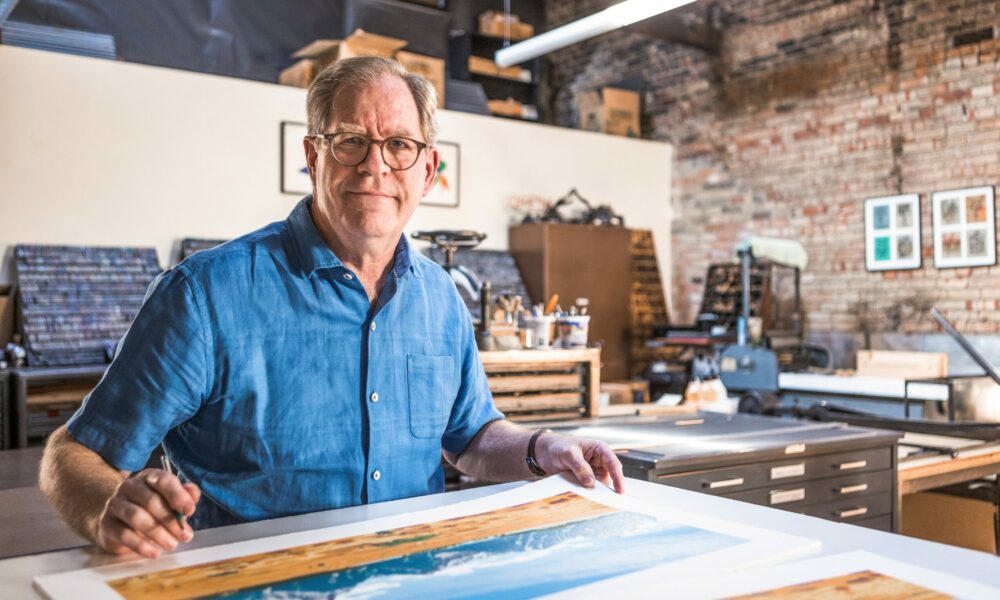
Today we’d like to introduce you to Rob Chipman.
Hi Rob, we’d love for you to start by introducing yourself.
As an artist, I am largely a self-taught, late bloomer. I loved creating art as a young boy and received a lot of encouragement from my teachers. Despite that encouragement, I never really studied art outside a few random classes in junior/high school and a graphic design class at the University of Utah. However, at the age of 70, those were a long time ago. My first experience with producing a block print was in high school. In fact, it was selected for some kind of exhibition for high school students. I didn’t think much about it at the time and for many years after.
I had never even heard of the term “reduction block print” until seeing some for the first time in a Carmel gallery in the 80s. I fell in love with their look and the process of producing them. I studied all I could by checking out books from the library (keep in mind these were pre-Google days). I experimented by doing a few prints back then, but never had the time to devote to it.
About five years ago, I saw an exhibition of Brad Teare’s (another Utah artist) woodcut prints at a local gallery. Seeing his beautiful work rekindled my passion for block prints. Shortly after that, I sold my business. I wasn’t ready to settle down into a life of retirement ease and, now having more time and flexibility, decided to become a full-time artist and continue to develop my process for creating this relatively unique art form.
I’m grateful for the great support I have received from mentors along the way, to those who have deemed my work worthy of awards, and to the many collectors who have purchased my work. However, I have also seen how difficult it is for the vast majority of artists (including myself) to get their work seen and sold. Because of that, I have made it my mission to expand and improve the art marketplace. While I hope to benefit from these efforts personally, I very much believe that “a rising tide floats all boats.” To help fulfill that mission, I accepted the nomination to become President of the Intermountain Society of Artists – an organization focused on helping all genres of visual artists improve their knowledge and skills, facilitating a supportive community of artists, and creating opportunities for artists to show and sell their work. I also recently organized a highly successful art marketplace featuring over 80 artists called “Art at The Park,” which was held at This Is The Place Heritage Park September 15-17, 2022.
Though I am supposed to be in my “golden” years, I’m as busy as an artist and art promoter as I ever was as an entrepreneur – and enjoying it more!
Can you talk to us a bit about the challenges and lessons you’ve learned along the way. Looking back would you say it’s been easy or smooth in retrospect?
To be honest, I’m amazed at how quickly my work has been recognized and acquired. If you would have told me five years ago, my prints would be hanging alongside the work of master artists in prestigious shows and galleries across the state and beyond, I’d have never believed you. The biggest struggle I have faced – and continue to face – is one of confidence. Given that I am mostly self-taught and haven’t had an extensive art education, I have a major case of “imposter syndrome.” Each time I begin a new work, a thought creeps into my mind wondering if this is the one where I’ll be discovered as a “fraud.”
In addition to periodic crises of confidence, the biggest struggles have come just in producing my prints. The process is painstaking and often frustrating. I never know how they are going to turn out until they are completed. Sometimes, I get several layers into a print edition and realize it’s not going to work. I then either start over or move on to another subject. Sometimes, I make mistakes that require me to start again. It’s very much a “trial and error” process, but I can’t say those efforts are wasted because I always end up learning something I couldn’t have learned in any other way. The other benefit of dealing with such a high-risk process is that it is also a high reward (when it works), There’s nothing like the exhilaration of pulling off the final stage of the print and having it meet or exceed your hopes and expectations!
Alright, so let’s switch gears a bit and talk business. What should we know about your work?
I do reduction block prints (woodcuts/linocuts) with multiple color layers. Once I have been sufficiently inspired to select a subject for one of my prints, I mentally deconstruct it down to its essential elements. These include the bare minimal colors, objects, shadows, etc. that will be necessary to recreate the image in such a way as to be similar enough to the original, but that will result in an entirely new, simplified creation.
The process begins with a photo or combination of photos from which I produce a very rough sketch. I typically do my sketches on tracing paper so I can easily transfer them to the block in reverse. For any areas that I want to keep white (or the color of the paper), I will first carve those sections out so they are below the printable surface and will always remain white throughout the process. I determine how many color layers each print will require and in what order to apply them at the outset, although I may add colors or eliminate them as I go along. I will then ink either the entire block or just a portion of it with the first custom-mixed color. Once the block is inked, I carefully place the paper on the block and run it by hand through the press to get the impression of that color on the paper. Registration of the paper on the block needs to be precisely the same with each layer or the end result will not be successful.
After the first impression has been completed on the full edition (I typically do editions of 10-20 prints), I carve away the area of the block that I just printed and then go through the same process with the next color layer. For example, if I’m doing 13 color layers and an edition of 20, that will require 260 individual impressions. Each time paper touches block there is a risk of error; it’s not unusual to lose prints along the way. Also, with the reduction process, there is the risk of carving away a portion of the block you shouldn’t have. That usually means starting over (sadly, I speak from experience.) After the final layer, almost all the printable area of the block has been carved away – hence the name reduction block print. By default, it is a limited edition, because it is impossible to create any additional prints.
Despite the risks, constraints, and challenges, I enjoy the process. I like that it’s a combination of both sculpting and painting and requires both right-brain and left-brain thinking. Most of all, I love the look of the finished prints. While they are a simple, minimal depiction, it is definitely simplicity born of a very complex, painstaking process. I like what Oliver Wendell Holmes said about simplicity and complexity and feel it is an accurate description of my art: “I wouldn’t give a fig for the simplicity [on} this side of complexity. But, I would give my life for the simplicity on the other side of complexity.”
Risk taking is a topic that people have widely differing views on – we’d love to hear your thoughts.
I spent the bulk of my career starting and building companies, which would likely categorize me as very much of a risk-taker. I get a great deal of satisfaction out of conceiving an idea and then building it. The financial rewards were never my primary focus. That’s a good thing, because none of my entrepreneurial endeavors turned out to be “home runs.” Starting over as an artist and this late stage of my life didn’t feel particularly risky from an economic standpoint. As I analyze my career, this was pretty much “par for the course.” The risks I felt were along the lines of “What if no one likes the art I create?” or “What if I put myself out there as an artist and I’m a flop?”
Experience has taught me that not pursuing your passions may be a bigger risk than taking the actions we typically perceive as being risky. I believe one of the reasons we are here on this earth is to learn and grow. And there’s nothing like stretching yourself with a little risk to achieve growth and wisdom – even if the end result is less than you hoped for. Had I not taken the risk of becoming an artist, I would never have experienced the double joy of creating art and then seeing it enjoyed by those who appreciate it – especially those who appreciate it enough to buy it! I also would have never been blessed by such wonderful associations with other artists, mentors, and other supporters. Hindsight tells me it was no risk at all.
Contact Info:
- Website: www.robchipmanart.com
- Instagram: @robchipmanart