



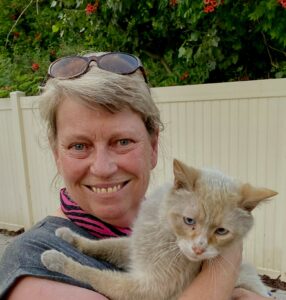
 Today we’d like to introduce you to Julie Davis.
Hi Julie, we’re thrilled to have a chance to learn your story today. So, before we get into specifics, maybe you can briefly walk us through how you got to where you are today?
A terrified young mother cat with kittens laying on a discarded paper bag under a shrub opened my eyes. She made me aware of “street cats” and I decide to help them. Call them street cats, homeless cats, community cats… most people don’t notice them, but poor behavior by humans is why there are so many of them. Recognizing that, I set out to help and care for the cats. I started by learning how to trap cats safely and correctly. Every wet, cold, hungry, pregnant, injured, sick, or dead cat I encountered reinforced my commitment. It was clear that many of the cats were breeding, putting additional strain on limited resources. There was not enough food, clean water, or shelter, and no health care. There were (and still are) sick, starving, suffering cats living and dying all around us. It wasn’t long before the hobby became a strong commitment and, really, an avocation.
We all face challenges, but looking back would you describe it as a relatively smooth road?
Hah! It’s been more like a roller coaster than a road. Animal rescue work is never-ending, and once you commit, you’re on for the whole ride. The highs are a rush, the lows are gut-wrenching, and it all goes by too fast—and that’s just the emotions that go along with caring. There are more tangible challenges, too. Every step in the trap-neuter-vaccinate-return (TNVR) process takes time and costs money. We drive all up and down the Wasatch front taking cats to and from veterinary clinics. We are blessed with wonderful caring, generous vets and clinics, but health care and medicine are still not cheap. Some of the cats need long term care and rehab before they can safely be returned to their communities. We take care of those cats in our homes. Accommodating those needs and the costs involved is a challenge and can be overwhelming.
Thanks for sharing that. So, maybe next you can tell us a bit more about your work?
I think of myself as a cat trapper and advocate for community cats. I assess a new trapping site, or colony, by scouting the surroundings, walking the neighborhood, and talking to the people who live nearby. I try to discover who the caregivers are, how many cats there are and where they live and eat, how many need to be trapped, spayed or neutered, vaccinated, and returned, and whether there are cats who will need more extensive health care. Before starting a trapping intervention, there is a fair amount of analysis, planning, collaboration, and communication.
Managing the size of a colony is part of the plan. If most or all of the cats in a colony can be TNVR’d, the population will stabilize, and the colony will be an asset to the neighborhood and the human community. As long as they are well fed and have reasonable shelter, the cats in the colony will keep other cats away and deter rodents from sharing their territory, so the plan always includes provisions for maintaining the colony. Caregivers need training and occasional coaching. Shelters and feeding stations need upkeep. And new cats in the colony (usually abandoned pets) need the TNVR treatment.
With a plan in place, trapping begins. TNVR takes skill, knowledge, and experience, and it takes plenty of time and energy. The boots on the ground TNVR work is what I love. Still, I spend much more time with cats that need what is really extended nursing and health care. Housing feral cats while they recover from injuries or from illness is much needed. There are only a few volunteer trappers who care provided this extended care for the cats. Fortunately, many of these cats are socialized to humans in the process, becoming sweet and adoptable. Finding foster homes or forever families for them is rewarding, and it frees up my time for trapping!
How do you think about happiness?
Working to improve the lives of street cats fulfills my need for service to my community. Seeing a contained colony of healthy cats makes me happy. I’m committed to working for cats and supporting the people who love and care for them. It’s a team effort. It provides a sense of community connection and caring that makes my heart happy. The only thing better is finding people who want to adopt a street cat. There is nothing like the love and gratitude that pours out of a “retired” street cat. Please consider sharing your home with one!


Image Credits
Julie Davis






Kato
January 20, 2023 at 5:22 am
Amazing commitment and thank you for your hard work!